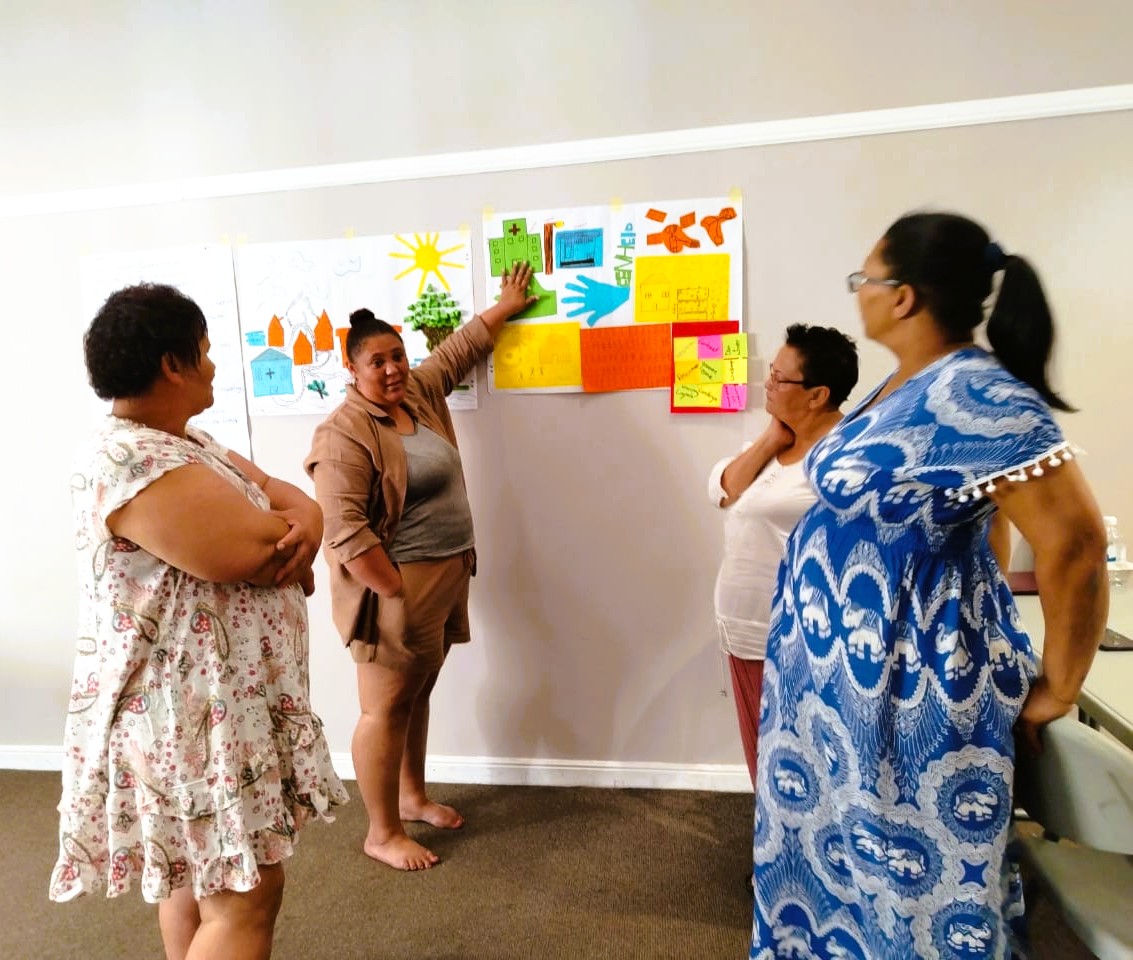
From July 2024 to December 2025, as part of Women Learning Liberation (WLL), WoMin’s 18-month popular education course, WoMin supported dozens of grassroots activists across six African countries, including South Africa, in articulating the damaging realities of extractive development in their communities and building better political analysis in their resistance work.
An important part of our Popular Education efforts, has been the close dialogue and training of feminist popular educators, or simply facilitators. It is the role of facilitators to create inclusive and participatory spaces where knowledge is co-constructed, and participants are encouraged to reflect on their lived experiences as part of their political analysis.
Insights from Namakwaland, South Africa
We found ourselves in the dry hills of Namakwaland, Northern Cape province, where we worked with VVVT – Vrywillige, Vooraf en Voordurende Ingeligte Toestemming (Free, Prior, and Informed Consent), a movement resisting mass land grabs on Indigenous Communal land for extractive mining projects.
From this movement, 10 women from different towns and villages, such as Pella, Concordia, Port Nolloth, and the Richtersveld, formed the South African WLL class, facilitated by Vanessa Ludwig, a South African educator working alongside movements like VVVT, supporting their critical thinking and organising efforts.
Although the 10 VVVT women work together, they live up to 100km away from one another. WLL offered a space to come together every 6 to 8 weeks, to learn and reflect on their struggles collectively. In conversation with Vanessa, who facilitated all sessions covering topics such as Colonialism, Capitalism, Development and Extractivism, among others, we learn insights on her motivations, challenges and key lessons acquired during the WLL.
What motivated you to become a WLL facilitator, and what kept you going during challenging moments?
I have been around women and related to land in the Northern Cape for such a long period of time, which was mainly about training, consciousness transformation and also Capacity building called Young Urban Women’s program and Forum for the Empowerment of women around LGBTI rights, specifically lesbian and bisexual women. WLL was the first time that I was going to work with a group of women around Climate change. So that was interesting. I was also interested in working with people like Shamim Meer and Shirley Walters, who I had known for several years, and not as closely, but I had worked at various times with them on small projects. So, I was interested in the women coming together and what would come out of this process.
For me, the most exciting thing was that it was a long-term process, because normally some programs as you know, we’re always parachuting. We come in, we do two, three sessions over a few months, and then we leave. Whereas for WLL, what was interesting for me was the time which gave participants the time to sit and reflect on the work they had done. And to come back with those reflections, and over time to monitor and see whether there had been any impact in terms of not just the thinking, but in terms of their organising.
The lessons for me were that the participants would teach us in terms of what is actually happening on the ground, because a lot of times, our advocacy, unfortunately, tends to be what I normally term high-level advocacy, we either address ourselves to the powers that be, the governing, the government. Or if we do training amongst people, it’s within organisations.
In this case the main focus was around actually building, for me, building women’s self-confidence, building their knowledges, but also building self-organisation. I think that last part for me, the self-organisation, the self-realisation was the most important aspect of this process. So, I was motivated because I was interested to see how this would go. Would this work, specifically with women from rural areas, where it’s very difficult to sustain organisation and organising.
What key lessons would you say you personally draw from facilitating the WLL, and how has it impacted your work?
Managing emotions because you are human too. And sometimes, yeah, the things that people say go against the grain of what you believe in and you can’t get angry. But there was once when I did get angry, and I realised it actually worked.
[The participants] didn’t think I had the capability to be angry, because I’d always blind to be as calm as possible about tensions and arguments within the group. I did learn this time, sometimes you must use the power you have as a facilitator. Because often we don’t want to use that power because it goes against the grain for feminist, the thing you must know when to use it and when not to use it, because you can. I mean, you know, it can become a pattern. So, to try and hold off on that but sometimes saying: Okay! Now, strategically, is the time to actually use it. It’s very difficult.
In South Africa, you sometimes used WhatsApp as a Popular Education space. How was the experience for you? What is the lesson?
I think it worked. On the one hand, the formation of the group, it meant that people were able to communicate via that as a group on the specific project or program. And that helps. So, if there were questions, or people had difficulty, people could pose them there.
I’d encourage people to take photos of the flipcharts, whatever you wrote on there. And a lot of times I’d get: Vanessa, can we call? Or some questions and I’d say: Okay, when are you available? I’ll call you. I’ll talk you through it.
So, it definitely worked. It helped a lot.
I would encourage that, if possible, wherever possible, that that is used as a communication tool, particularly with the way the program was structured around the assignments.
Using the tools available for us
When we think of Education, we often imagine classrooms and textbooks, but Popular Education can happen anywhere, with whatever tools we have available.
VVVT brings together activists and community members from different towns and villages, that are far from one another and travelling can be expensive and time-consuming. Additionally, transport options are limited, making regular meetings difficult. In this case, WhatsApp became the preferred method of communication.
Platforms such as WhatsApp can be useful for popular education processes, given that they allow for the sharing of different media (videos, photos, text, etc.) and create ongoing opportunities for reflection and collective learning beyond traditional Education spaces.
In South Africa, it was fitting to use WhatsApp given that the women had access to cellphones and relatively stable internet connection. It is in spaces like these, facilitated by people like Vanessa, where resistance and resourcefulness meet, that Popular Education takes living form.
The Women Learning Liberation (WLL) is an 18-month popular education course, crafted by the WoMin African Alliance. This course aims to build the political and organisational capacities of grassroots women leaders who are actively engaged in resistance against the damaging realities of extractive development across the African continent.
This blog is part of a series highlighting the work of the Popular Education facilitators that supported this course.

