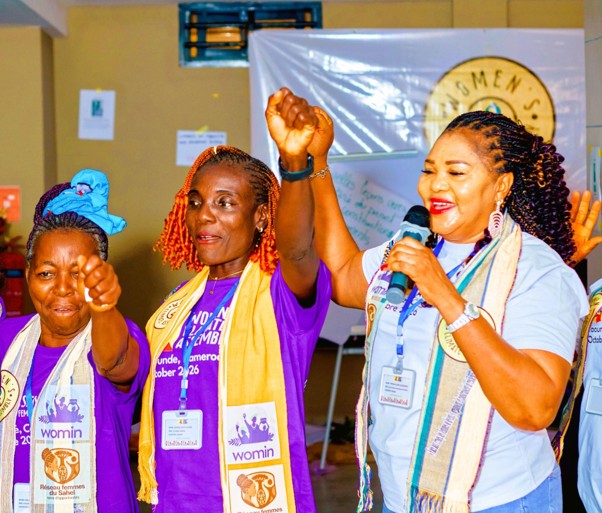
“Empowering women is a radical way to transform the world!” – Ivorian activist
The fourth regional Women’s Climate Assembly (WCA), held in Yaoundé, Cameroon, from 5–8 October 2026, concluded with a powerful reaffirmation of African women’s determination to defend their lands, territories, livelihoods and communities, and to demand climate justice and reparations.
Under the theme, “Our lands, our voices: African women united for climate justice and reparations!”, the Assembly convened over 75 women community leaders, activists, feminist organisations, civil society groups and allies from twelve countries including Burkina Faso, Cameroon, Côte d’Ivoire, the Democratic Republic of Congo (DRC), Guinea-Conakry, Liberia, Namibia, Niger, Nigeria, Sierra Leone, Senegal and Zambia.
The gathering provided a vital space for women on the frontlines of the climate crisis, extractive industries, land dispossession and environmental destruction to share their experiences, strengthen relationships across borders and build collective strategies for change.
As the Assembly closed, one message rang clear: African women are not merely bearing the costs of the climate crisis. They are leading the struggle for solutions, defending their communities and shaping the future they want.
“There’s an adage in my village that women cannot build a nation. The Women’s Climate Assembly has proved that women build nations. We counter this adage with the unity and solidarity of African women!” – DRC activist-participant
Turning shared struggles into collective power
From communities confronting oil and gas expansion and destructive mining to women defending forests, seeds, water sources and ancestral lands, participants brought forward the lived realities of communities too often excluded from decisions about their territories and futures.
Through collective reflection, popular education and movement-building, women connected struggles that may take place in different countries but are rooted in common systems of exploitation, inequality and environmental destruction.
Designed by women activists and members of the WCA Steering Committee, the thematic teach-ins explored a range of political concepts, questions and practices, including:
- The erosion of farmers’ seeds: A challenge for building resilient and sustainable food systems. What solutions are there for preserving our seed heritage?
- Nature Commons: The defence of the Congo Basin’s forests.
- Counting the Costs of Mal/Bad Development and Demanding reparations: The case of the African Development Bank campaign.
- Fighting some of the false solutions to the climate crisis: Gas extraction, enclosure of our forests and lands for carbon trading, green conservation and more.
- Building democratic, accountable, ‘loving’ leadership: Why are these principles so important to feminist leadership? What else do we feel is critical to leading as feminists?
- Lessons on organising and movement building: Growing National/sub-regional grassroots movements.
- Building knowledge from what we know: Building feminist popular knowledge as the basis for Building Women’s Power. How can we go about doing this locally in our communities and beyond that.
The WCA celebrated the knowledge, resistance and organising power of rural, Indigenous, peasant and working-class women. The Each One, Teach One sessions embodied this spirit of knowledge-sharing, collective learning and liberation. On Day Two, participants exchanged practical skills, crafts and tools, sharing techniques for making baobab candies, producing eco-briquettes from cassava and creating seed bricks to cultivate and protect Indigenous seeds. Weaving, cloth-dyeing, beadwork and other practices also featured, affirming the value of knowledge held, practised and passed down through generations of women.
The gathering reaffirmed the importance of strengthening a Pan African ecofeminist movement that recognises the connections between the climate crisis, extractivism, gender injustice, food insecurity and the loss of community control over natural resources.
It also reinforced a fundamental principle: communities must have the power to determine their own futures, including the right to say NO to destructive development projects that threaten their lands, livelihoods and ways of life.
Climate justice means reparations, not empty promises
Africa contributes relatively little to global greenhouse gas emissions yet faces disproportionate climate impacts. Women in rural, coastal and forest communities frequently bear the burden of climate-related losses while also confronting the effects of land grabs, pollution, displacement and the expansion of extractive industries.
The WCA challenged approaches to climate action that reproduce these injustices or treat African communities as passive recipients of false solutions.
Climate reparations must mean more than promises of future assistance. They must include substantial and accessible resources to address loss and damage, support adaptation, restore ecosystems, and strengthen community-led alternatives. They must also confront the historical and ongoing responsibility of wealthy, high-emitting countries and corporations for the climate crisis.
African women demand accountability, not charity; justice, not debt; and development that puts the wellbeing of people and the planet above corporate profit.
“African women are strongly connected to the climate. We are the ones doing agriculture. We are connected to our environment. Decisions cannot be taken without women.” – Cordelia Ndagha, Ministry of Women’s Empowerment and the Family, Cameroon
From Yaoundé to the world: the work continues
The Assembly’s significance extends beyond the four days spent together in Yaoundé. It lies in the relationships and solidarities strengthened; the experiences, knowledge and skills shared; the collective analysis and perspectives deepened; and the foundations laid for sustained action across communities and countries.
At the heart of the WCA is a call for climate reparations as key to climate justice for Africa. This call will continue to shape the advancement of an ecofeminist Pan African permanent assembly that recognises that climate solutions cannot be imposed from “above.” Women and communities whose lives, territories, and futures are at stake must shape them.
“Beyond celebrating the success of hosting this event, we are excited to transform this momentum into a permanent space driven by concrete actions on the ground at our different national levels.” – Véronique Mbole, Cameroon
Building on the inaugural African Women’s Climate Justice Day held this April, the conclusion of the 2026 Women’s Climate Assembly marks the beginning of the next phase of movement building. The country delegations agreed to undertake solidarity actions, linking local community struggles to national, regional and international advocacy and collective actions at strategic moments.
ENDS
For media enquiries contact:
Veronique Mbole – Green Development Advocates | Cell: +237 79392311
Connie Nagiah – WoMin African Alliance | Cell: +27 0827300653

