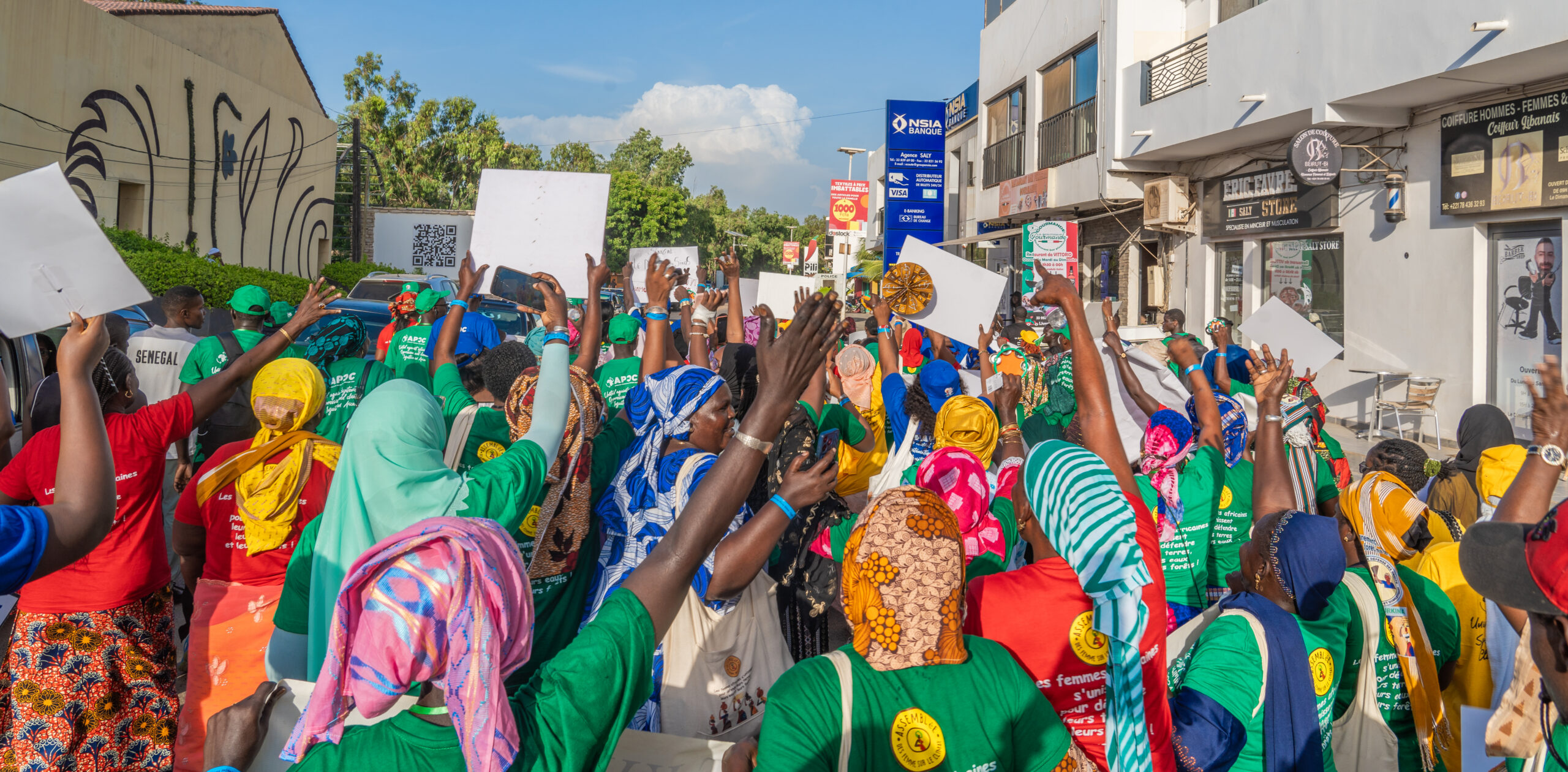
On 17 August, SADC leaders concluded their 46th summit in Durban, against a backdrop of heightened xenophobic protests, threats, and forced repatriations. August is Women’s Month in South Africa commemorating 70 years since women marched on the Union Buildings fighting against apartheid and pass laws. However, this month has been marred by the recent spate of Afrophobia and xenophobia across the country. SADC’s communiqué recorded an update from South Africa on migration governance and called for coordinated regional dialogue on the drivers of migration. It did not explicitly name xenophobia or Afrophobia — even after months in which Black African migrants have faced intimidation, violence, and pressure to leave South Africa. In an Open Letter to the SADC Heads of State and Government, WoMin African Alliance, together with The People’s Dialogue, calls for those Heads of State to place xenophobia and Afrophobia in South Africa on its formal agenda, issue a clear public resolution, and commit to measurable regional action.
Those 20 000 courageous women across race, class and religion marched on 9 August 1956 to confront the Apartheid regime’s institutionalisation of white supremacy and racial capitalism by controlling Black life and movement. The Pass Laws inscribed that control, requiring pass books at all times, and described Black people as “aliens” and “illegal” in the country of their birth. Sophie De Bruyn, the only living leader at this year’s commemoration, shared “that the freedom we marched and bled for is in reality a painful paradox. How can we celebrate our past victories when our current realities are so deeply disappointing and distressful?”
The pass laws did not simply restrict movement — they dictated who belonged where, who could work, where they could live, and who counted as fully human within South Africa’s borders.
This historic day of protest was about fighting for a free, democratic South Africa in which all peoples, regardless of race, class and gender, could be emancipated and live with dignity and equality. Already liberated countries on the continent stood alongside Black South Africans in full solidarity, offering a home, bearing the brunt of economic pressure and military assault, especially for frontline states.
While the pass laws are painful history, the current reality for Black South Africans falls far short of our freedom dreams. Much of Apartheid endures in lived memory — continued spatial injustice, the deepest economic inequality globally, and more than 33.6% unemployment.
For WoMin African Alliance, rooted in Pan African feminist politics, this is no coincidence. Women’s Month cannot be commemorated as mere nostalgia — it must be treated as unfinished business. The emergence of Xenophobia and Afrophobia results from deep, intersecting crises in South Africa, as set out in our statement on Afrophobia and Xenophobia.
The root cause of this crisis is the neoliberal economic policies implemented by the South African government, along with a long history of racial capitalism in which Black people were exploited for cheap labour to build the economy but have remained economically and politically excluded. What we are witnessing is the crumbling and disintegration of our society. Today, South Africa’s huge unemployment rate represents millions of lives suspended in a state of permanent insecurity. This disintegration has the greatest impact and consequences on Black women.
Impacts on women
Women face the most inequality, earning 23% to 35% less than men for the same work, and accounted for 77% of all job losses in 2025. They are concentrated in low-income, informal, or precarious employment such as domestic work. Women-headed households face a roughly 60% chance of being poor. This places a triple burden on women, who bear most unpaid domestic work and child-rearing — labour unrecognised in national accounts and that hampers their economic advancement.
These statistics represent structural violence rooted in inequality, patriarchy, social dislocation, and dispossession. Rather than confront the state’s failure to transform the economy and property relations, create decent work, or provide basic services, migrants become easy scapegoats for crises produced by capitalist and neoliberal policy. The unemployed South African is encouraged to blame the Zimbabwean street vendor, the Ethiopian spaza shop owner, or the Somali trader, instead of asking why wealth remains concentrated in White capital, why services are collapsing, and why opportunity is so scarce. Leading afrophobic proponents like March and March and Operation Dudula now use the language of the past to identify those who “do not belong”: “illegal,” “alien,” “undocumented,” or “foreign national” — regardless of a person’s legal standing, the dismal state architecture for regularising status, or the context they fled. As under Apartheid, one’s humanity and belonging is determined by a document.
This narrative tries to separate African migrants from our communities, when they are embedded in them — our neighbours, tenants, family members, fellow people experiencing many of the same struggles. In the words of Audre Lorde, “the master’s tool will never dismantle the master’s house.” The effect is to make exclusion sound reasonable — even righteous — while the underlying dehumanisation stays the same.
From April 2026 till now, the South African government states that more than 77 184 people have been forcibly repatriated to Zimbabwe, Malawi, Nigeria, Ghana, Uganda, DRC, and other countries. It has also called for reimbursement of repatriation costs to some countries. But this is not new; the waves of xenophobic attacks like May 2008, which killed 62 people and displaced over 100,000, remain a devastating marker.
This is where the parallel to 1956 becomes impossible to ignore. Pass laws were never really about paperwork; they were a tool for managing a population the state had already decided to exploit and blame. Today’s anti-migrant rhetoric performs the same function: it takes the legitimate rage of the unemployed and dispossessed and points it at the wrong target, protecting the actual architecture of inequality from scrutiny.
The solidarity that already exists — and the solidarity Women’s Month demands
It would be a mistake to tell this story only as one of division. Across the country, South African women and movements have organised to challenge Xenophobia. Working class women have hidden and protected African traders during outbreaks of xenophobic violence — traders who had extended them credit, built relationships with them, and become part of the fabric of their communities, their African neighbours and people renting from them – this is real solidarity. The impacts on migrant women are particularly hard through providing care, support, and sustaining livelihoods, and even birthing babies outside embassies. This is a sobering and shameful reality.
This Women’s Month we should never forget: our real communities cross the divisions created by passports and borders, sustained by long, vital, and loving connections that literally kept South Africans alive and played a central role in our struggle for freedom. Exiled South Africans survived because people across the continent sheltered them, fed them, and fought alongside them. From Cape to Cairo, we must build Pan African solidarity.
For WoMin, our solidarity is not separate from our feminist politics; it is an expression of it. African feminism has always insisted that liberation cannot be partial — that a freedom which protects some African women while criminalising others is not liberation at all. Africa’s enemies are colonialism and imperialism.
Unfinished business
Honouring Women’s Month means refusing the false choice between caring for struggling South African communities and defending the dignity of migrants when both are victims of the same racialised economic system. It means remembering that those women who marched were not fighting only for themselves, but for a South Africa — and a continent — that is emancipated.

