Across Africa, colonialism was not only a project of economic exploitation and political domination; it was also a project of language and cultural control. Colonial rule sought to determine not only who governed and who had access to resources but also elevated European languages as symbols of intelligence and authority, while African languages were systematically marginalised.
African literature captured this contradiction. In So Long a Letter, Mariama Bâ writes from within the tensions of expressing African women’s realities through a language inherited from colonial rule. Ama Ata Aidoo’s novel Our Sister Killjoy, similarly, exposes the uneasy relationship between English as a language of literary expression and also as a reminder of cultural displacement. These reflections continue to resonate with present-day realities across the continent, where language remains deeply entangled with questions of power, culture, identity, class, gender, and belonging.
Today, access to education, legal systems, government services, and political participation in many African countries still depends heavily on competence in colonial languages such as English, French, or Portuguese.
In Nigeria, for example, although more than 250 languages are spoken across the country, English remains the dominant language of governance, education or even policy discourse. Similar dynamics persist elsewhere on the continent. In Tanzania, although Kiswahili is the national language, many court judgments continue to be delivered in English. Citizens who do not understand English must depend on interpreters to comprehend legal decisions affecting their lives.
For peasant and working-class women confronting mining, oil extraction, logging, large-scale agricultural investments, and other extractive projects, language exclusions carry profound consequences especially for rural women whose language is deeply tied to their relationship to land, water, forests, food systems, ancestry, and survival.
Where information about government-proposed projects is often delivered in foreign languages without clarifying their implications including the terms of the proposed project, the risks it poses, the compensation being offered, or the legal mechanisms available to challenge it, their ability to give meaningful consent or organise resistance against it, then language becomes a question of power.
Language in Women Learning Liberation and Translation as a Tool of Resistance
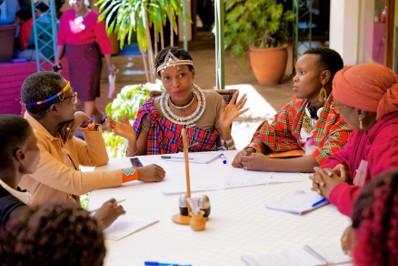
Language was central to the development of Women Learning Liberation (WLL), WoMin’s 18-month political education course for frontline women activists. The first WLL cohort began in July 2024, bringing together 60 women from Cameroon, Guinea Conakry, Ivory Coast, Madagascar, South Africa, and Uganda. From the beginning, WLL understood political education not as the transfer of knowledge from experts to communities, but as a process of collective learning rooted in women’s own experiences and struggles.
The Ugandan WLL cohort spoke eight languages and represented five different community struggles. English could provide a common language for some discussions, but relying exclusively on it would have risked excluding women from fully expressing their experiences, questions, analysis, and political imagination. WLL therefore deliberately incorporated interpretation into the political education process. Facilitation moved between English, Luganda, Runyoro, and Kinyarwanda, while participants themselves became active in ensuring that interpretation was taking place.
As Ugandan facilitator Sostine Namanya explained: “Language can work, but language needs to be budgeted for, language needs to be prepped for.”
In many African contexts, people come from diverse language backgrounds and often speak multiple languages. While English or French may serve as common languages, reliance on colonial languages can reproduce unequal power relations and weaken movements. Interpretation and translation therefore become powerful tools for building multilingual and robust movements capable of deepening collective participation.
In 2024, WoMin launched materials supporting the Right To Say NO campaign in East Africa in five languages, which join a plethora of knowledge materials and resources such as its award-winning film, Women Hold up the Sky (2021) and a comic book, Voices against Extractivism: Sheroes for Change. The act of interpretation and translation is itself a tool of resistance because it challenges the concentration of power in colonial languages and allows more people, especially women who have historically been excluded from political processes, to participate fully in political education and movement building.
Language and the Production of Knowledge
Peasant and working-class women have articulated sophisticated understandings of ecological interdependence in their own languages. Women describe how forests provide rain and clean air, how rivers sustain communities, and how the destruction of ecosystems directly threatens their survival and future generations.
At the 2021 Zimbabwe Feminist School, a participant captured the ecofeminist understanding that emerged from the discussions: “Once nature is disturbed you have disturbed or destroyed a woman’s future.”
This insight did not emerge from academic texts or scientific reports but from lived experience and embodied knowledge developed through established relations and interaction with land, water, forests, and agricultural systems.
Ecological consciousness often exists prior to the introduction of formal ecofeminist terminology, which is usually conceptualised in English or French, thereby erasing African women’s experiences and knowledge. The marginalisation of Indigenous languages thus also becomes the marginalisation of Indigenous epistemologies.
Towards Language Justice
It is through language that people make meaning of their experiences, share knowledge, build relationships, and organise collective action. Colonial languages have long functioned as instruments of violence and exclusion for peasant and working-class communities, particularly women.
If African ecofeminist movements seek to contribute to genuine social transformation, they must embrace the languages that people understand and use in their everyday lives. Only by centring Indigenous languages alongside practices of interpretation and translation can social movements deepen collective political consciousness. It is through such practices that popular pedagogy can remain accountable to the communities with whom it works and contribute towards a feminist future in which all voices are heard.

