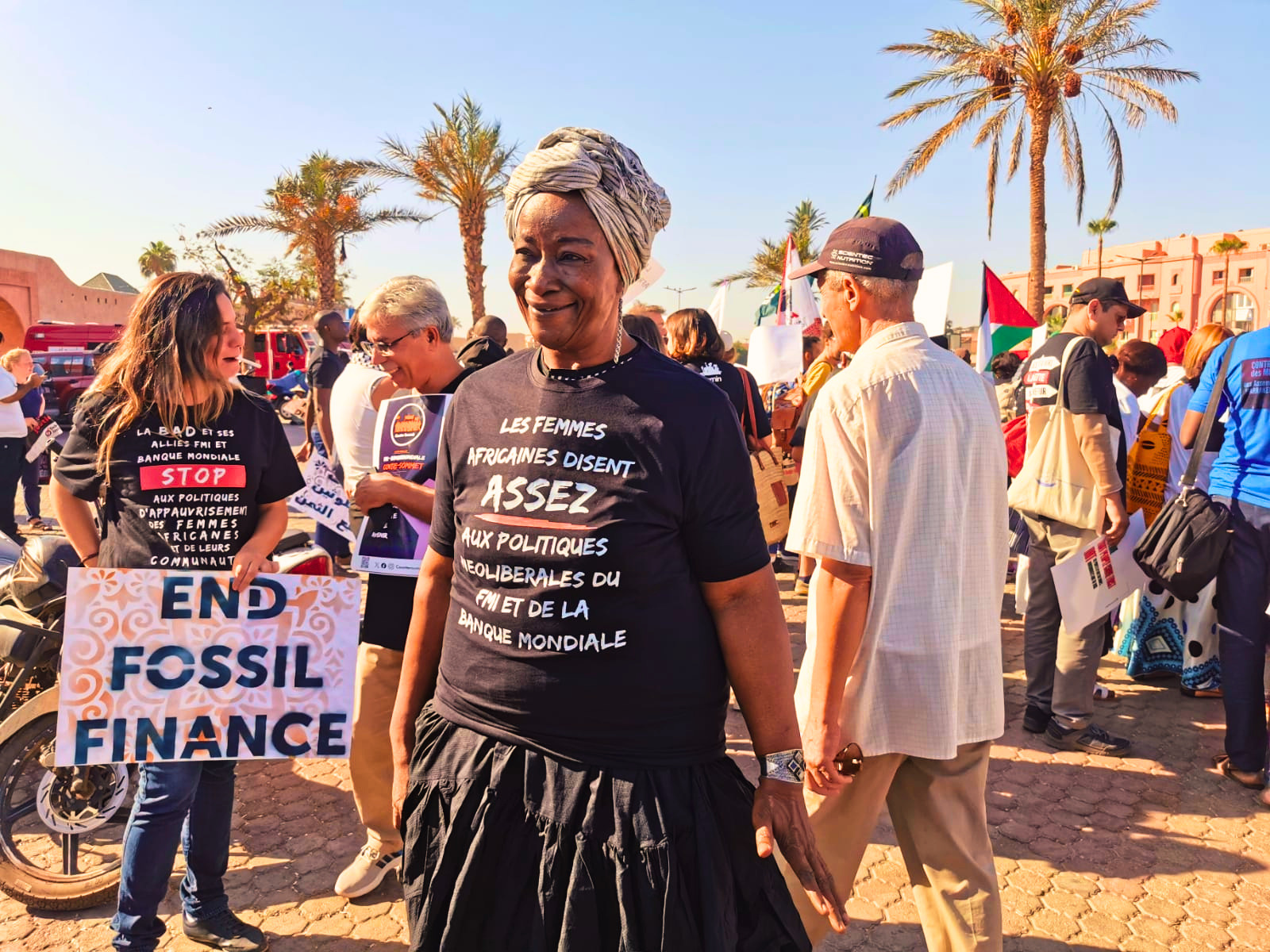
Through WoMin’s work alongside African women organising against extractivism, against the drivers of the climate crisis and its impacts, the destruction of the commons through false solutions, unjust energy transitions (and generally a world order that serves a minority over the global majority), we have been asking: what is the full range of impacts and costs in the face of environmental and climate impacts? Who and whose work absorbs these impacts and costs? And what would repair mean from the perspective of women, their communities and the ecosystems they care for and are cared for at the frontline of the climate crisis, where centuries of continued systems of accumulation by dispossession and destruction meet?
Our experience shows us that reparations cannot simply be another form of compensation. They must confront the very systems producing the harm – extractivism, odious and illegitimate debt, colonial legacies, patriarchy, racism, and corporate power promoting more false solutions whose aim is not climate justice but profit. Reparations must indeed offer us all a real chance to build Pan African feminist futures that centre care, including the restoration of the commons, and the conditions that make life possible.
Connecting the “c-words” – colonialism to climate reparations
The recent African Symposium on Climate Reparations in Mombasa, Kenya, started on that same note: “there is no “c-word” that we cannot bring into conversations on climate reparations”, argued a comrade in his opening remarks. And indeed, the current climate disorder1 is a historical process, and Colonialism (the c-word that in other climate justice spaces some shy away from) is part and parcel of it. As is, we argue at WoMin, capitalism. What is more, not only do climate reparations need to address colonialism and neocolonialism, but also the solution to the climate crisis will not be found within capitalism. Or as Audre Lorde put it, “… the master’s tools will never dismantle the master’s house. They may allow us temporarily to beat him at his own game, but they will never enable us to bring about genuine change.”
Not only we need our own tools, but also a broad alliance, as broad, yet united in principles and analysis, as broad and urgent is the task ahead. And the symposium offered an important space to bring together many working for reparations across the continent and in the diaspora, in conversations navigated along four main tracks: rights of nature and ecosystems stewardship; finance, debt and tax justice; law and human rights; and lived realities from frontline communities.
And the timing matters. We are entering the Decade of Justice and Reparations for Africans and People of African Descent, while the debt crisis in Africa continues to exponentially grow and deepen climate vulnerability, false climate solutions continue to expand, further threatening the commons millions of Africans depend upon for their everyday subsistence, and the African Court considers an Advisory Opinion on States’ obligations in the climate crisis.
As powerful expressed in an open letter which emerged from the symposium, a Pan African position and action plan for climate reparations is urgent, but it cannot be constructed only through states, legal and financial tools. Those at the frontlines absorbing the costs of extractivism, ecological destruction and climate disruption have to shape what counts as harm, what constitutes repair, and what must stop. And importantly, we need to organise at all levels the collective power to make repair possible.
African women united for climate justice and reparations
This was the task of the 4th Women’s Climate Assembly (WCA) in Yaoundé, Cameroon, held in early October under the theme, “Our lands, our voices: African women united for climate justice and reparations!”. The Assembly convened over 75 women community leaders, activists, feminist organisations, civil society groups and allies from twelve countries including Burkina Faso, Cameroon, Côte d’Ivoire, the Democratic Republic of Congo (DRC), Guinea-Conakry, Liberia, Namibia, Niger, Nigeria, Sierra Leone, Senegal, and Zambia.
Oh ancestors, watch over Africa and let everything return to Africa! If we are coveted today, if there are wars, it is because our ancestors bequeathed this land to us. They did not abuse its riches. They used them sustainably. So we ask our ancestors to guide us during this Assembly, so that peace and food may return to our lands, so that we may once again be the people who produce seeds and ensure food production. – Dorothée Lisenga, DRC, in her opening prayer to the ancestors
Dorothée’s reflection speaks not only to food sovereignty but also to the defence of seed commons and communal systems of production that have sustained African societies for generations. Women’s struggles for reparations are therefore inseparable from struggles to protect and reclaim the commons that underpin collective wellbeing.
Since its origins, the WCA has provided vital space for women on the frontlines of the climate crisis, extractive industries, ecosystems dispossession and environmental destruction to share their experiences and analysis, strengthen learning and solidarity relationships across borders and build collective strategies for change.
When we first received information about oil and gas exploitation in Senegal, we were already familiar with exploitation in the Niger Delta. Through the WCA, we learned a great deal. We realised that there was a gap between the information we had received from the government and the multinational company responsible for the exploitation, on the one hand, and the realities on the ground in the Niger Delta, on the other. There was a problem. The reality was quite different: it was not necessarily a story of wealth or development. This is what led the women we are working with today to begin raising awareness among communities living in the Saloum Delta. – Aby Dia, Senegal
As the Assembly closed, it was clear that African women are not merely bearing the costs of environmental and climate impacts. Nor are they passive recipients of false solutions. They are defending their forests, seed systems and communal lands, demonstrating that protecting and regenerating the commons is central to ecological sustainability. Women are leading the struggle for solutions, placing accountability and climate justice at the centre of their efforts. It is reparations and not false solutions that put the wellbeing of people and the planet above corporate profit.
Today, we are therefore making a strong appeal to all African countries and nations: let us come together! Unity is what we are asking for. And today, we are not asking anyone for permission to speak about climate change nor to challenge the multinational companies that plunder and destroy us at will. We are claiming our rights!
We will also address the question of debt. We should not have to pay these debts. We are not responsible for them. They are the ones who owe us. We did not cause climate change. – Sakinatou Ouédraogo, Burkina Faso
This is the call for reparative justice, and the task at hand as the Assembly moves into a new phase, consolidating solid foundations at the national level for the next 24 months. The goal is to build a movement capable of standing up to polluters, financiers like the African Development Bank (AfDB), and colluding governments and elites; a grassroots movement that sees through the demand for reparations, so that, as a sister aptly put it, “we can pass on to our children the Africa that our ancestors bequeathed to us.”
1 Climate disorder is the preferred name by Haitian activists, instead of a more neutral “climate change”… as in the climate did not just simply change, it was altered by centuries of dispossession by accumulation, from land and communities to ecosystems and atmosphere commons.

