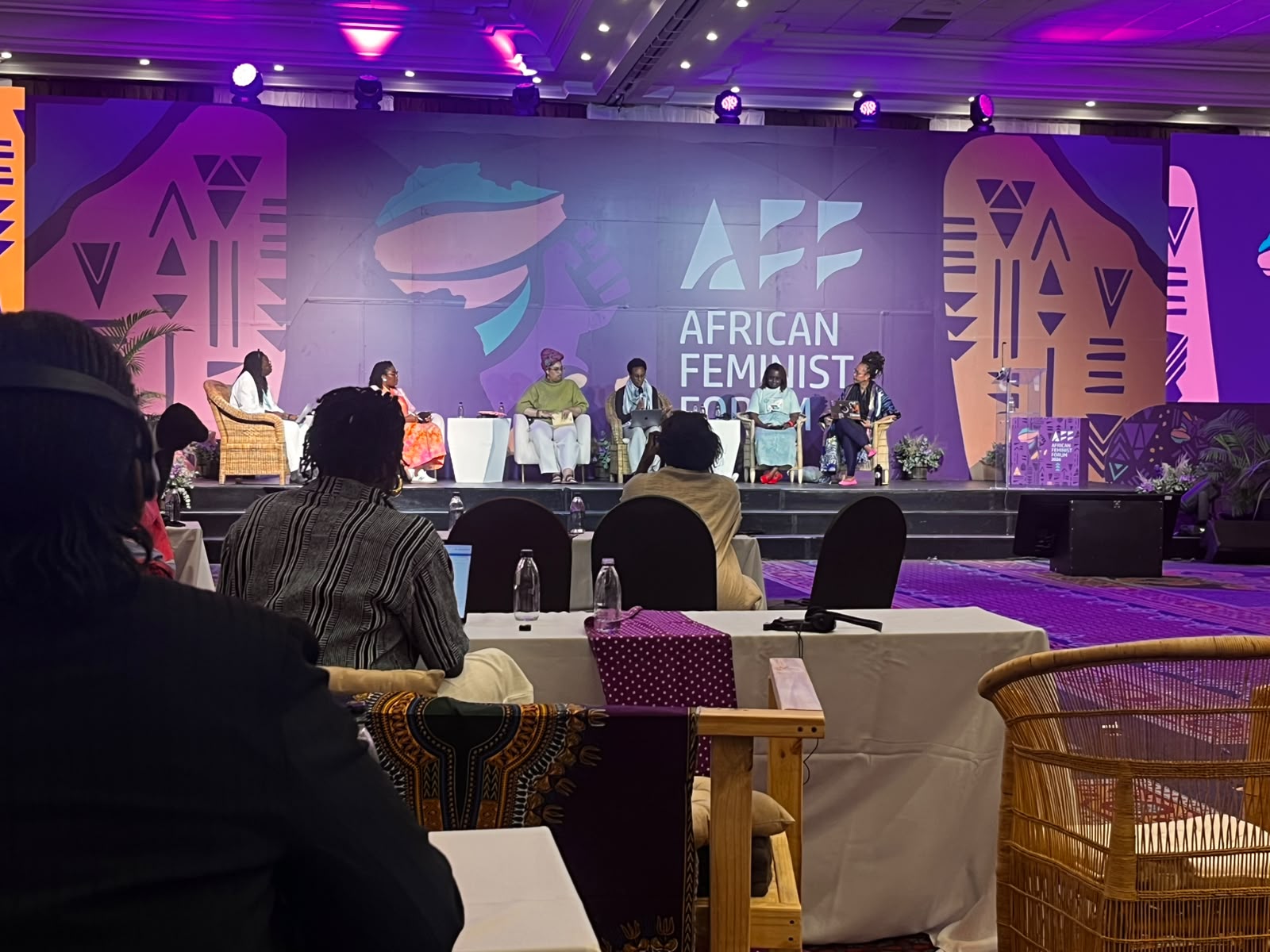
Attending the fifth African Feminist Forum (AFF) in Windhoek, Namibia, this past August offered fresh perspectives and the opportunity to engage with a group of inspiring African women. Convened under the theme “Hasego – We Have Arrived!”, this pivotal forum brought together feminists from across the continent and the diaspora to reflect, strategise, connect movements, and advance feminist visions for justice and collective liberation.
The event also marked the 20th anniversary of the African Feminist Charter. As L. Muthoni Wanyeki highlighted in her keynote address, “twenty years of building, resisting, imagining, crafting feminist alternatives across our continent,” participants were reminded of the critical importance of feminist spaces for sharing solidarity and building connections around common struggles facing their communities. The celebration bridged past and future through storytelling circles that revisited the journeys of African feminists, complemented by a dynamic panel offering thought-provoking reflections on Africa 30 years from now.
The discussions on envisioning the future were particularly thought provoking. There is an inherent challenge in projecting the future, especially in a context marked by sliding democracy, militarism, conflict, and the displacement of communities due to mining, while global economic injustices continue to widen. Over the course of three days, listening to a diverse array of speakers, it became evident that both past and future dialogues compel us to consider how we can construct feminist futures and what it takes for feminist movements to endure long enough to realise them.
The answer lies in imagination and organisation.
Imagining plays a critical part and it is inherently political
One speaker imagined a dystopian world in which African land had been sacrificed for data centres and mineral extraction, workers had become disposable elements of an artificial intelligence supply chain, and technology had made surveillance and abuse more pervasive. Another speaker imagined a future in which communities had reclaimed technology and defining it for themselves being a tool for restoring indigenous farming, transmitting knowledge, healing communities and reviving nature.
The difference between these futures is not simply the pace and application of technology embedded in our daily lives. The difference is the distribution of power. Power to determine who owns the land? Who owns the technology? Who decides what is produced? Whose knowledge and expertise is valued, who benefits from economic growth, and who is protected versus who is rendered disposable.
Addressing these questions is crucial to build the future and the alternatives we seek but these are questions that feminist movements have been tackling over many decades in their organising. These challenges reflect the reality that marginalised communities across Africa are already experiencing. A present and future where data centres deplete critical water supplies, mineral extraction displaces communities, young people work under precarious contracts and women continue to carry disproportionate burden of unpaid care work. Rising organised anti-gender and anti-rights movements attacking women’s bodily autonomy and gender diverse rights, coupled with global authoritarianism shrinking civic space, is not difficult to imagine precisely because parts of it already exist in our society and in legislation. That is precisely why feminist imagination is important and why it is under attack.
The second important tool is organising, because imagination alone is not sufficient to build futures. As one of the panellists clearly articulated “the desired future will not come about without persistent, disciplined and coordinated care centred feminist organising”. Organizing in and with the communities where power is, centering care in organising and requires thinking of feminist solidarity that is more material. Another speaker challenged us to think beyond political solidarity towards practical infrastructures that allow people to survive. She imagined feminist pension funds, unemployment funds, healthcare support and collective mechanisms through which movements could sustain women and organisations when philanthropy retreats, lives become more precarious, and people age or become ill. This is perhaps one of the most pressing challenges facing African feminist movements.
What future are we building?
Discussions at the African Feminist Forum (AFF) fostered a shared understanding that the future should not be a passive destination but rather a result of intentional political organising made today. We must ask ourselves: What kind of future are we building? If we arrive in 2050 and technology has made exploitation more sophisticated, if our forests are gone, if our young people work without security, if care remains feminised and unpaid, if queer and trans people continue to fight simply to exist, if our movements have fragmented under repression and if feminists are still exhausted from trying to sustain themselves through inadequate resources, then we must reflect on the choices that led us there.
But there is another possibility. A future in which African economies are organised around human provision rather than extraction. A future in which care is public infrastructure. A future in which technology benefits communities rather than surveillance capitalism. A future in which land, knowledge and seeds are treated as commons. A future in which queer existence is not treated as an exception to African life but a human right. A future in which feminist movements have built the material infrastructures necessary to care for their own people. That future is possible, but as reiterated by the participants, possibility is not inevitability. Perhaps the most realistic statement shared during the forum may have been that victory is not certain, challenging the liberation movement slogan “a vitoria e certa” (victory is certain). “The struggle continues but there is no guarantee of victory. Our work is to ensure that, when victory comes, it is African, feminist and queer”.
WoMin is actively shaping the alternatives through supporting grassroots women to defend communal land from large-scale extractive projects that displace communities across Africa. As we advance this mission it is crucial that we engage younger women leaders to bring new perspectives to propel our movements forward. It is through effective collaboration with like-minded organisations that we continue to weave our collective future.

