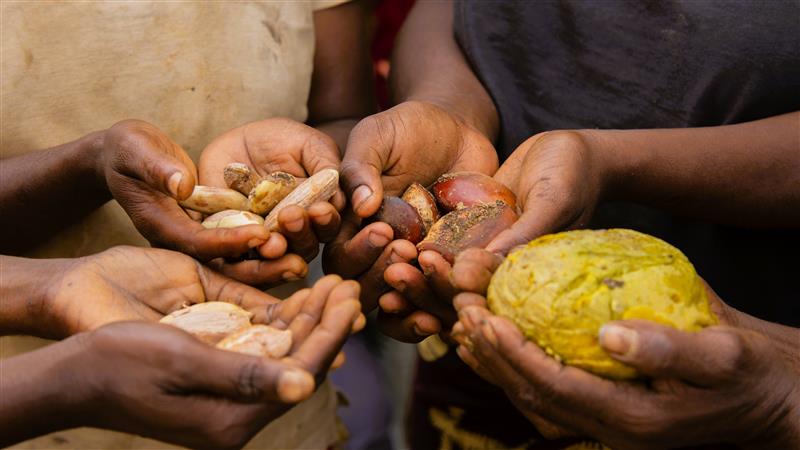
The Commons are collectively governed lands, waters, forests, climate, air, and public services that sustain life and social reproduction, rooted in shared laws, intergenerational knowledge, and collective responsibility. They include the public and social systems such as health, education, care, and basic infrastructure that communities steward, defend, and rely on to ensure collective wellbeing. As articulated in WoMin’s Struggles for Securing Communal and Indigenous Forms of Land Tenure in East Africa, the Commons are living spaces of radical democracy and ecofeminist alternatives, defended especially by women against enclosure, privatisation, militarisation, and capitalist exploitation.
When I think of my childhood in the farming village of Mbiafun Nkwono in Nigeria’s Niger Delta, I remember what we shared as Community Commons. Women and men farmed and harvested together, saved seeds, planted trees, dug village wells, baked mud bricks, kept livestock, practiced organic farming, and built houses as a collective. This isn’t unique to Nigeria. In many African communities, long before the arrival of European settlers, people led a way of life that today is understood as “The Commons”: the collective stewardship of land, water, forests and life-sustaining resources. No single person, no small group, was ever allowed to exclusively appropriate The Commons as theirs alone, as it was understood their importance for the sustenance of everyone and stewarded through custom, tradition, and the quiet authority of the interdependence between all forms of life.
Colonialism and Enclosure of Commons
In the 1880s, British settlers invaded Nigeria, resulting in the systematic enclosure and privatisation of communal resources. Colonial powers, backed by military force, imposed the concept of private ownership, transforming land and communities into commodities that could be bought, sold, or seized. Large-scale private farms, including Casplex Farms, Shonga Farms, and Olam International’s rice operation, acquired tens of thousands of hectares of formerly communal land. Colonial land policies, such as the Public Lands Acquisition Ordinance, empowered the state to compulsorily acquire customary lands, convert them into state land, and grant leases to private interests, breaking apart communal tenure systems. The Land Use Act of 1978 further centralised control over land in the hands of the state, undermining customary Commons and opening the door to individual and corporate appropriation.
Following Nigeria’s independence in 1960, the government adopted a state led development model that later accelerated privatisation under the Structural Adjustment Programme, supported by the IMF and World Bank. As Andrew C. Okolie notes in his book Economic Crisis, Structural Adjustment, And Prospects for Political Stability in Nigeria’s Third Republic, between 1983 and 1993, about 88 public commons were privatised or commercialised. The Structural Adjustment Programme led to massive retrenchments across industries, the destruction of informal livelihoods, and widespread repression of unions, students, and activists, causing severe economic hardship and social dislocation for ordinary Nigerians.
This privatisation and enclosure extended to biodiversity commons, driving the loss of species and ecological imbalance. Water became increasingly commodified, contributing to pollution and the depletion of essential resources, while corporate capture of the atmosphere from fossil fuel extraction produced climate chaos. It turned living territories into sites of extraction and sacrifice, as it has happened in the Niger Delta where millions of gallons of oil tanks are being extracted by multinational oil corporations such as Royal Dutch Shell, Total and others, while gas flares, oil well blowouts, and destruction of livelihoods have driven the environment to its knees. All these have little or no benefits to the local communities.
During the 2022 African Women Climate assembly held in Port Harcourt, Niger Delta, a Nigerian woman activist testified, “Our rivers are filled with crude oil. We can no longer fetch water. Our land is destroyed. Our fish are gone. When women go to farm or fetch water, they are raped. Armed men enter homes and violate women. Communities live in fear.”
Here, the enclosure of commons not only steals resources, it also destroys safety, dignity, and peace.
What Has Been Lost
Women across Africa bear the heaviest burden of the enclosure of Commons because privatization of land, water, and biodiversity, together with customary land tenure systems deny women ownership and inheritance rights, even though they remain central to food production and household survival. They remember what Commoning looked like in their communities. “Our community had systems of fighting hunger. We would lend goats or cows to struggling neighbours. After an agreed time, the animals were returned, but their offspring remained,” a participant from Cameroon noted, during the 2022 Women’s Climate Assembly. Another woman from Sierra Leone added that, “It was easy to give your neighbour a piece of land to farm and return it later. Land was not private property to be hoarded”.
Their testimonies revived my own memories. I remembered my grandfather paying a penalty for cutting a tree on a forbidden day. Decisions about crops, grazing, irrigation, and forest used were made collectively and democratically. Community life was rooted in trust, care, and reciprocity.
Over the years however, Land commons ceased to be a source of life. It became a source of profit. The enclosure of shared resources for profit enabled corporate expansion and fuelled overlapping crises including poverty, food insecurity, water scarcity, biodiversity loss, and climate change.
During a visit to the Saloum Delta in Senegal, a woman cried, “Our farming, fishing, and hunting are declining. Oil exploration has destroyed our livelihoods. Our nets are ruined. Women are abused. There are no roads, no hospitals, no schools, no jobs,” whilst another woman from Burkina Faso added, “We used to live in joy, surrounded by nature. Now our water is polluted. The trees are gone. Our people are migrating. The state is deaf to our suffering.”
When ecosystems are exploited beyond their limits, communities are pushed out of resource-rich lands as they lose their means of survival.
Towards an Anti-Capitalist Ecofeminist Practice
As primary providers of food and caregivers within households and communities, African women experience the impacts of land dispossession and ecological destruction most directly and therefore stand at the forefront of defending and reclaiming The Commons.
Where capitalism has encroached on, privatised, or destroyed the Commons, and restricted communities, especially women from accessing economic, cultural, and political spaces, movements have emerged to resist this violence.
Ecofeminist practices such as ilima and letsema in South Africa bring neighbours together for collective farming and harvesting. In Kenya, Chama groups allow women to mobilise resources, invest collectively, and build economic autonomy. In the Niger Delta, women are restoring mangroves damaged by extractive industries while rebuilding subsistence economies. As shared by Martha Agbani, environmental activist and founding director of the Lokiaka Community Development Center, during the 2025 Nigerian Women Climate Assembly, “We have trained hundreds of local women to restore over 2.6 million seedlings in Ogoniland, reviving vital shellfish habitats.”
Women are coming together and proposing development alternatives, where dignified livelihoods and the future of their communities and the environment is a priority. For African women, reclaiming The Commons is an everyday practice, where they take back their role as custodians of Nature and bring in solutions rooted in democratic values and ecological sustainability.
Such efforts as displayed by women across the continent, from the Niger Delta to South Africa, is a testament to the fact that the struggle we are engaged in is a just one and is rooted in the material conditions of these communities, who continue to remind us that The Commons are a mutual good for all and thus should be defended against private interests.

