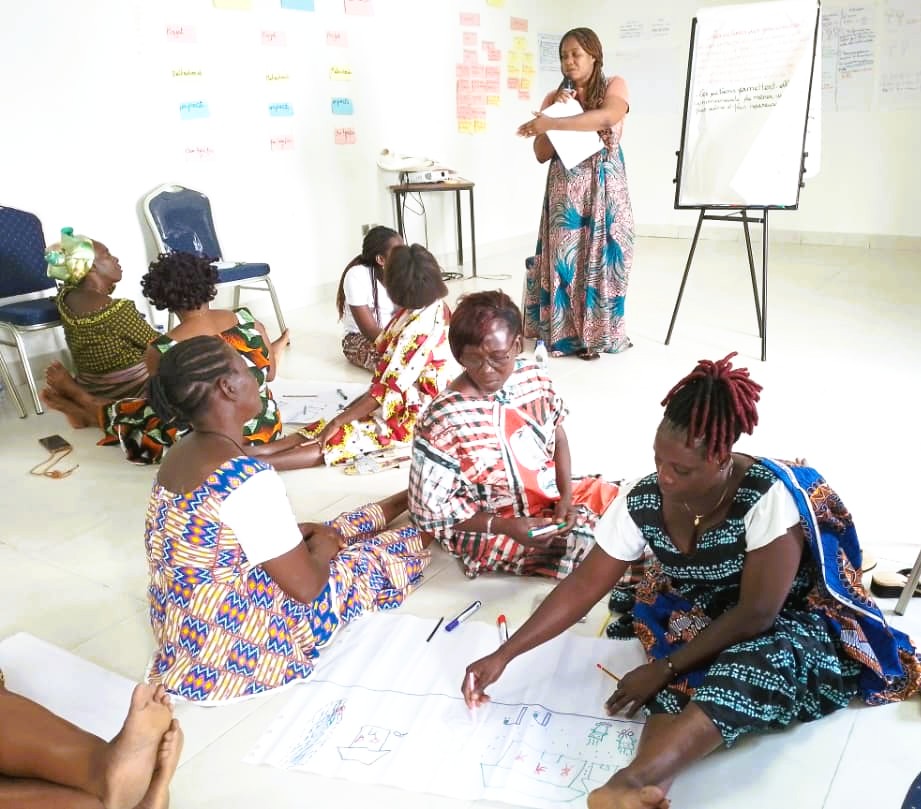
Women Learning Liberation is WoMin’s 18-month popular education course held from July 2024 to December 2025, designed to strengthen the knowledge, skills, and collective power of peasant and working-class African women activists organising to resist extractive development in their communities. The course was implemented in six countries across West, East and Southern Africa, including Ivory Coast.
The 10 participants in Ivory Coast were women who are leading efforts to defend their lands and territories against mining and agroindustry plantations. Through their activism, they challenge violence against their bodies and resist displacement in their communities.
To support the implementation of the course, in each country a facilitator is assigned to lead the WLL sessions. In Ivory Coast, it was Reine Baimey and she shares her experiences of witnessing women speak out across colonial boundaries and stand in solidarity with one another, throughout the WLL course.
What motivated you to become a WLL facilitator, and what kept you going during challenging moments?
I think what has motivated me, um, actually, I have been approached by the leadership of WoMin to be the facilitator, because it has been a bit challenging for them to identify a political sister with a politics that align with the work of WoMin. And it was a bit difficult to find someone, and I was really interested in facilitating that process also, because I think that I was curious about the popular education space and the methodologies, and also because it was an opportunity to be in direct contact with the women in struggle. And yeah, it’s always a rich experience to meet women on the ground.
I think the political process of the WLL also was something interesting to me, a long-term process. It was the first time that we had that kind of long-term connection, so I was really excited about that. What kept me going, I think it’s the connection with the women. After each module, women were sharing how the course helped them move, even if it was like a small change in their life, or they were seeing things differently because of the training. I think it was really valuable and precious to me. And I think it speaks to my personal and professional engagement in supporting women organising and movement and building a movement for liberation. I think that this has been the motivation all along that has kept me engaged within the process.
What key lesson did you personally draw from facilitating WLL, and how has it impacted your work?
I think the key lesson is that, and I think this is all about popular political education, is that to see the change happen, we need to educate people, and to invest in that. People need… our women, you know, if we want women to be the first catalyst of the change that they are calling for or they are struggling for, they also need to understand the political dimension of the struggle so that they are not passive to the process or to the struggle. They are really active and then can drive the change.
And now I can identify myself as a popular educator, with all the skills and abilities that I have been able to develop through the process. All my work is, I think, popular education is everywhere now, in the way I think, how I engage within a community. Every interaction with the women we work with is shaped by that profound understanding of making the space popular, making the space political, ensuring that women are at the center of the process. So, it has shaped my work and my way of understanding my work.
In Ivory Coast, sessions were held in multiple locations to be closer to women in their communities. How was this experience? How did it shape the learning environment?
When we realised that Module 3 of the training focused on the climate crisis, we thought it might be a good idea to hold Module 3 in a place where the impact of the climate crisis was visible, in order to make the module more tangible by allowing participants to experience firsthand the reality faced by local communities.
The city of Sassandra, where one of the three communities is based, is facing coastal erosion and seemed ideal for helping us achieve our dual objective, namely, bringing the training closer to the women to reduce not only the resources they had to use to travel to the center (the capital, Abidjan). But also, with a view to challenging the norms that constantly push communities towards urban centres, reversing this dynamic at all levels. The first level was to ensure that women felt comfortable and safe in a learning environment familiar to them, and the second level was for the organising team (the NGO and the facilitator) to step outside their comfort zone to critically question the privileges we enjoy and immerse ourselves in the realities of women in their communities.
During the evaluation of Module 2, certain discriminatory attitudes on the part of the staff at the hotel where we were staying were reported by the women, and it was also in response to this situation that we deemed it appropriate to try holding the various modules within the communities.
The experience proved to be positive in that the women expressed their satisfaction at being in familiar spaces, and this helped reduce their stress levels, as staying in certain hotels did not always allow them to feel at ease. They also mentioned that they felt valued because the training was held in their community/hometown. More broadly, holding the training in the different communities gives meaning to the space because it allows the participants’ realities and lived experiences to be connected to the concepts and experiences developed in the course, while conveying a powerful message: that they have value, that their lives matter, that their realities and lived experiences are respected, and that their cultures are honoured.
Grounding Learning in Belonging and Solidarity
African women, and especially peasant and working-class African women, are often not found in spaces where important decisions about their lives are being discussed, and even when they are present, many times these spaces aren’t designed to encourage their full participation and engagement.
This is also the case with most conventional meeting venues, such as hotels or business halls, where women might feel displaced and thus, uncomfortable. When designing from an African Ecofeminist Popular Education perspective, one must pay attention to the learning space, as it is just as important as the content.
Both from a material but also a symbolic point of view, moving the WLL sessions from the urban center to the rural areas where the participants are from, contributed to creating a space that better reflected their lived realities. This proved to bring a sense of pride, to strengthen trust and to build confidence.
Grounded in solidarity and shared learning, the experience of WLL in Ivory Coast proved that women are not only collectively imagining new ways of living that challenge patriarchy, imperialism, and militarism, but they are already working in ways that reflect ecofeminist values and that uplift their communities.
The decision confirms that when women are heard and equipped with knowledge and the right tools, they become powerful drivers of transformation in their communities.
This blog is part of a series highlighting the work of the Popular Education facilitators that supported this course.

