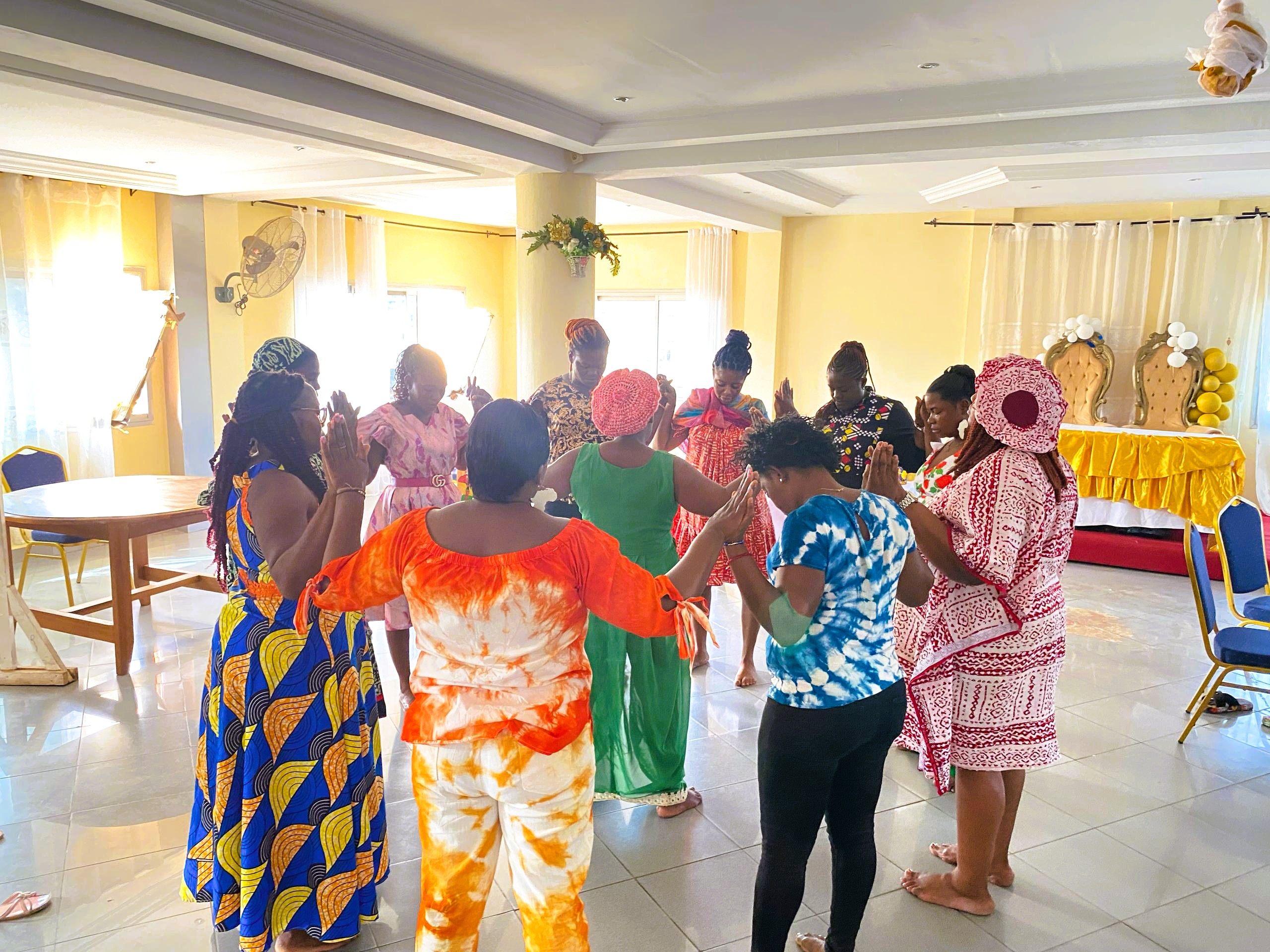
WoMin’s long-term political education course, Women Learning Liberation (WLL), began in July 2024 and brought together grassroots women activists from six African countries: Cameroon, Ivory Coast, Guinea Conakry, Madagascar, South Africa, and Uganda.
In Cameroon, the WLL became a vibrant space for women to build trust, share knowledge, and speak freely. The 10 Cameroonian participants are affected by three projects: two agroindustry and one Dam. They expressed, often for the first time, the harsh realities they face, particularly experiences of sexual and physical violence. These are issues that women often conceal during short visits or surveys.
The facilitation in Cameroon was under Floriane Carrele’s responsibility. She has been working in GDA (Green Development Associates), our country host, contributing to the sustainable development of African tropical forests while defending indigenous communities. Carrele shares with us her insights in this interview.
What motivated you to become a WLL facilitator, and what kept you going during challenging moments?
So, when we completed a training in South Africa and returned to Cameroon, I was selected for the very first day by WoMin to be a facilitator. And when I ran the training again in South Africa, I realised that I had further developed many of my skills, particularly in terms of my approach, and also thanks to the facilitators who were there. It was a sharing of experiences between us.
Now, when we returned to the country, on the very first day, I felt a bit under pressure, because I was thinking will the 10 women be able to keep up? I had doubts about the training: would I, even with my organisational responsibilities, be able to deliver this training properly? Would I be able to really convey what was necessary to these women? I asked myself a lot of questions.
The first module, I was still very committed because I saw that the women were just as committed. It’s true that at the start, the women were also asking themselves questions, but as time went on, through Module One and Module Two, more and more communities became engaged. And what motivated me was the commitment of this community, but also the knowledge and the wisdom that all these communities had within them, which I can say was hidden. These are communities that we support at the grassroots level, and there are many women who really had hidden knowledge.
This training allowed me to really delve deep into women’s lives, to truly understand what women go through, and to gain a growing understanding of the realities women face on the ground. Because when we go out into the field, it’s a two- or three-day mission, we are close to the communities, but this training, given that it lasted 18 months, really brought me even closer. It brought my work closer to this community, allowing us to dig deeper.
Whenever we had proper discussions, the women became more open day by day, module by module. They were more open, more at ease, and they truly expressed the realities they face. We were working on violence, for example, and it was the women who told us how they had been raped, how they had been beaten. These are things that women always tend to hide during short visits or surveys, but because we stayed in touch over a long period, we built trust. They felt truly comfortable and shared a lot.
Honestly, what kept me going was the commitment of those communities, their proactive attitude, the way they respond and ask questions, and the trust that grew between us over time.
What key lesson did you personally draw from facilitating WLL, and how has it impacted your work?
One of the lessons from this training course is, first and foremost, the duration of this training – that is to say, the programme’s length of 18 months. That is commendable because most of the project activities we carry out are short-term projects or short-term training courses.
An 18-month programme really enables us to empower people, to build capacity, and to gather the outcomes of this capacity building. Because more often than not, when we run certain training courses, we don’t immediately see the outcomes, but here, the fact that the training lasted 18 months allowed us to already see the impact of that training.
It enabled us to understand the communities’ problems, which will allow the organisation to support them more effectively. That is one of the main impacts.
Another impact is really the fact that the communities have been transformed in their various locations. The women who took part in this training have become leaders. They’ve become something else compared to how they were at the start. Many didn’t know much, didn’t know how to speak up, but today they are the ones acting as facilitators in the communities.
They are the ones giving speeches at roundtable discussions. They are the ones who have the courage to bring members of their community together to raise awareness. They are the ones who have the courage to go and speak with the chiefs, because it is not just any woman who can speak with the chiefs.
We are getting a lot of feedback from the ground. Even recently, during the launch of the book we produced, one of the women who had completed the training spoke in a way that was completely different from before. The way she expressed herself and conveyed the impact of the forest on their community really struck me. It really moved me, because this is the kind of transformation we are seeing.
Also, the knowledge that we ourselves as facilitators have been able to gain from these communities is a key lesson. Communities know a great deal that we ourselves, whether we are on the ground or intellectuals, do not know. I think these communities are truly ready to achieve a great deal today.
And even after the training has ended, we are still seeing the effects. For example, some of the women gathered others in their communities to address the issue of violence, and they are already passing on what they have learned. So, it is like a chain for disseminating this training within their communities.
Political Education takes time
Political education, as we understand it in WLL, is a gradual process that involves reflecting on real experiences, learning new concepts, questioning old concepts and discussing tensions. This is an exercise that requires patience and consistent engagement, which is what we tried to do during the 18-month WLL journey.
Facilitators play a key role in encouraging critical thinking and helping participants build confidence that can have lasting impact in their resistance work. This can only be achieved with trust, as so well putted by Carrele. Trust allows conversations to move beyond surface-level engagements and creates the conditions for more sharing, deeper understanding and solidarity.
Long term ecofeminist popular education courses such as WLL can only be successful if working class and peasant African women and their communities are engaged, feel heard and have the space to reflect critically on their lived realities. Through this process, political education becomes more meaningful and transformative, strengthening communities fight for justice.
This blog is part of a series highlighting the work of the Popular Education facilitators that supported this course.

