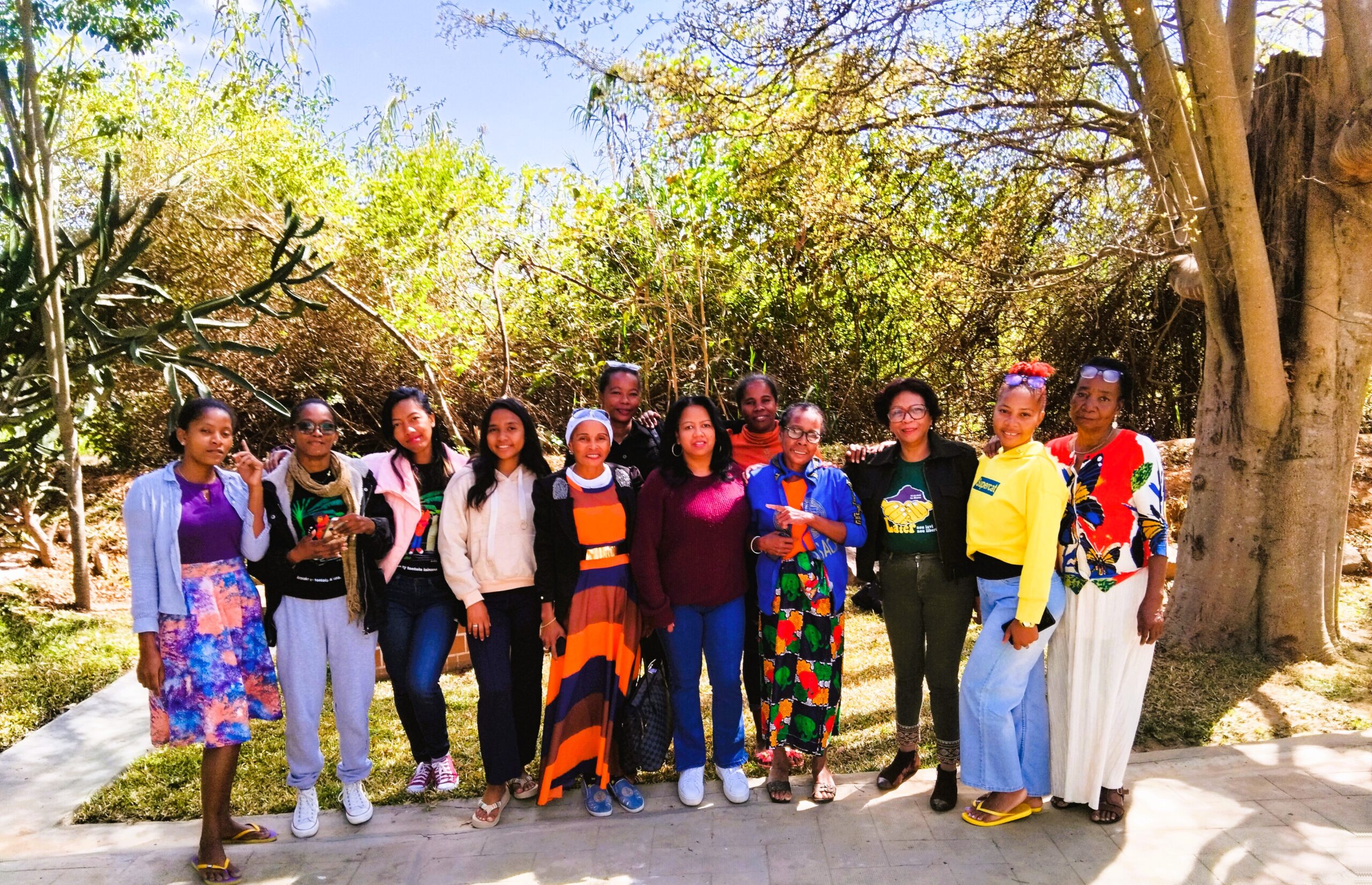
Seven facilitators from South Africa, Cameroon, Côte d’Ivoire, Uganda, Madagascar, and Guinea participated in WoMin’s 18-month popular education programme, Women Learning Liberation (WLL), from July 2024 to December 2025.
The WLL course was designed to equip grassroots women activists in extractive communities with the skills and knowledge needed to fight for justice. The course wouldn’t be successful without the support of facilitators who could apply our Ecofeminist Popular Education approach and effectively lead sessions using the appropriate methodologies and practical tools.
In Madagascar, participants came from collectives and organisations, including youth movement leaders, fighting the advance of mining corporations in their communities. Two facilitators, Zo Randriamaro and Volah Andriamanantenasoa were selected to lead the course, given their extensive work in defending communities fighting extractivism in the country through CRAAD-OI (Centre de Reserches et d’Appui pour les Alternatives de Développement – Océan Indien).
As a Pan African feminist researcher and academic, Zo Randriamaro reflected on her experience facilitating the WLL course in Madagascar. In working with the participants, who were mostly grassroots activists, Zo learned a pedagogical approach that differed from her usual academic teaching methods.
Tell us more about not being familiar with popular education when you initially joined as a facilitator.
Yes, so not being a popular educator and then being a popular education facilitator in the WLL process, I had to really revisit my past work as a trainer and my work as a feminist trainer. I had to rethink and reconsider the approaches that I used then in relation to education targeting rural women, especially rural women who are not literate, so I had to reconsider my methodology.
In terms of the training, I had to bear in mind the concept that is central in popular education, which is that there is no superior or inferior in terms of knowledge, that the rural women, even if they are those who are to be trained, they also have knowledge and skills that are as important as those of facilitators.
I had to really keep the need for humility and recognising that the woman, the rural woman, came to the course with a wealth of knowledge and skills that must be taken into consideration and respected.
What key lesson did you personally draw from facilitating WLL, and how has it impacted your work?
Um, I think the key lesson that I took from the WLL process is making women’s voices heard and amplifying those voices as essential to bring about any kind of systemic change. For my own work, we are now planning for something like the WLL process but that will take place over a shorter period: an activist school with content and with a similar methodology. I think this is the very concrete example that I can give about how the WLL has impacted my own work.
In the previous answer, you had to reconsider your methodology, given that you were not initially a popular educator, but the experience with WLL and facilitating the process made you reconsider your methodology. Could you say more about that?
I reconsidered my methodological approach in terms of explaining very abstract and complex concepts in a way and in a language that rural women can understand and grasp. I had to go through the process of trying to find simple pedagogical methods to make women grasp the process of the concepts and deal with them during different sessions. So, I think that’s the main lesson that I learned. It’s about forgetting about the technical and academic, complicated jargon, and trying to find ways to explain concepts to rural women so that they can understand.
The role of facilitator in Ecofeminist Popular Education
WoMin’s approach to Ecofeminist Popular Education recognises the connections between the exploitation of women and the exploitation of Nature, and it creates participatory spaces where grassroots women can make analysis and build strategies for resistance, using their own knowledge as a starting point.
The role of Ecofeminist Popular Education facilitators is to guide participants to build theory from their own lived experiences. To achieve this, we challenge traditional roles of teacher and learner and share power, recognising the knowledge held by women, especially African women in rural areas who experience the burden of extractivism, capitalism and colonialism in their everyday lives and know how violent these systems are in their communities, to people and the environment.
In training and supporting facilitators like Zo, we hope to strengthen feminist organising by encouraging collective leadership and creating spaces where people of all literacy levels and backgrounds can contribute meaningfully to their communities.
This blog is part of a series highlighting the work of the Popular Education facilitators that supported this course.

