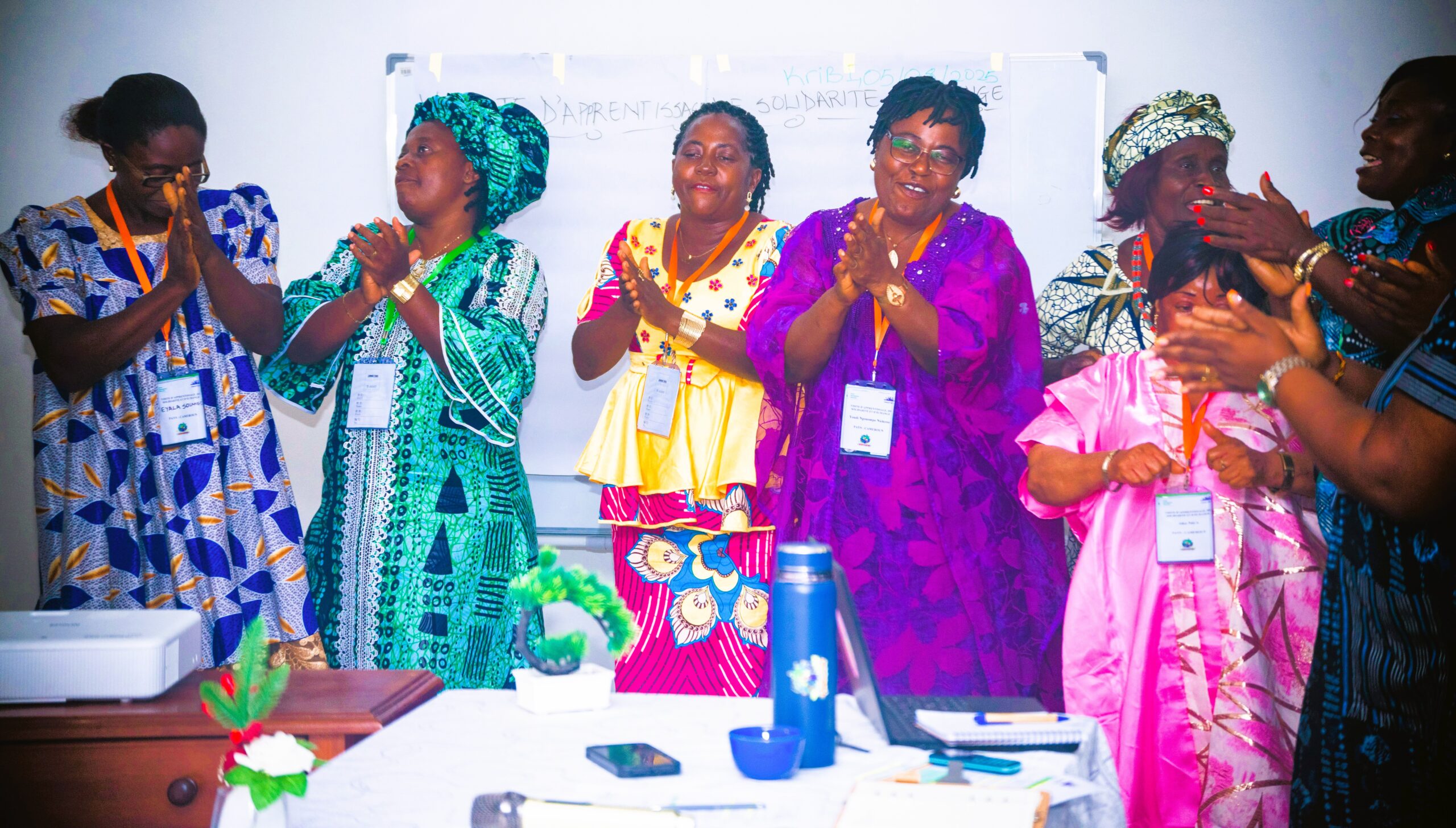
From 4-8 August 2025, participants from Senegal, Cote d’Ivoire, Senegal, Niger, Burkina Faso and Congo Brazzaville gathered in Kribi, Cameroon, to share their experiences and struggles in the face of extractive industries that negatively impact the lives and livelihoods of women, indigenous and local communities. They found resonance despite their different contexts, and discussed ways to counter extractivism and strengthen their understanding on the Right to Say NO. Below are two powerful testimonies written by women activists Blanche Simona Ngokoumounga and Ramma Erode Samanou Li Tchilombo from Congo-Brazzaville.

Blanche Simona Ngokoumounga – We need to be empowered by the Right to Say NO!
Women engaged in the fight against harmful policies and practices of the extractive industry from Niger, Burkina Faso, Cote d’Ivoire, Senegal, and Congo-Brazzaville carried with them petals of love and bowls filled with courage, energy, dynamism, vitality, and strength – gifts they were determined to share with their sisters in Cameroon.
The women gathered for an exchange and solidarity visit co-hosted by WoMin and Green Development Advocates (GDA). The Right to Say NO is a truly powerful concept that I followed with interest as valiant warrior women from West and Central Africa shared their stories.
This meeting allowed me to immerse myself in the different struggles African women and communities impacted by the extractive industries. I met women environmental defenders from Niger and learned about the ecofeminism of women from Cote d’Ivoire. With admiration, I listened to the struggles of women impacted by gold mining exploitation in Burkina Faso. The stories of Senegalese women from the Saloum Islands and how they are mobilising against oil exploitation was truly inspiring.
And the bravery of Cameroonian women! For a few years now, they have been grappling with agro-industrial companies that have taken over their land. Our site visit to the village of Apouh left us speechless. Palm oil trees flood the village and its surroundings as far as the eye can see, planted by the SOCAPALM (Société Camerounaise de Palmeraies) at the expense of the women and the community who are deprived of cultivable land.
The Apouh community can no longer carry out agricultural activities to meet their needs. The situation is the same in the Campo locality, whose forests have been ravaged and colonised by palm oil trees from the company CAMVERT (Cameroun Vert SARL). A monoculture that destroys biodiversity and women can no longer draw on natural resources for survival and life from it.
During the exchange, I also learned about the fight of the women of Batchenga who are demanding reparations after their village was destroyed by the backflow of water from a hydro-electric dam. Those of the Tahm Forest who have lost their sleep since the announcement of the construction of a road that will cross their villages and their forest.
All these women, far from bowing their backs, hold their heads high in their grief as they fight against mega industries and for their rights. Their voices demand reparation for the harm caused by all these industries. They are women who have learned to resist projects that, instead of bringing them better lives, destroy their living environment.
WoMin and partners have supported many of these women in their organising – educating and information-sharing on the Right to Say NO to projects that prioritise profit while not benefiting the local people. Women should no longer allow these industries, the authorities, or even the men around them to make decisions alone – they must be included, because they are the most impacted by industrial activities.
The stories shared by women from Cameroon, Senegal, Niger, Côte d’Ivoire, and Burkina Faso during this exchange and solidarity visit all bear striking similarities. These are also the stories of women in my country, Congo-Brazzaville.
The difference lies in how we respond. While their sisters have found the strength to raise their voices, to say NO, and claim their rights, the women in Congo remain and are just starting to share important information and mobilise awareness.
This is why we need training on the Right to Say NO. We need to be informed and empowered about our rights!

Ramma Erode Samanou Li Tchilombo – Together, African women will move the world!
Congo-Brazzaville is a country rich in natural resources and whose extractive activities are the causes for several environmental impacts on women.
This solidarity visit was a great opportunity for me as a lawyer-activist and human rights defender working with communities living near oil and mining operations in the departments of Kouilou and Pointe Noire in Congo-Brazzaville. It allowed me to deeply understand the origin of extractivism and its consequences and also to learn from the ongoing struggles of women in other countries. The exchange also equipped me with vital tools to better support and train the women in my communities on the Right to Say NO to extractive projects that do not respect their human rights and destroy their villages, sacred forests, cultivation spaces, streams and watercourses, and much worse.
Women are the most impacted and affected group in the extractive industry due to their strong presence in agriculture, use of rivers and water sources to maintain households, farm, and other activities. Seeing their voices marginalised in favour of profit is deeply unjust. The arrival of extractive companies in our communities is supposed to improve our precarious living conditions, to develop our localities or villages, not bring us down.
The exploitation of natural resources, which is supposed to benefit first and foremost the impacted communities, does not. During this visit, witnessing and hearing how women from other countries fight every day is a great source of inspiration and motivation for communities and movements in my country. Witnessing how women in countries across West and Central Africa are pillars of true change in their communities offers lessons.
The fair and equitable extraction of resources in our communities cannot be done without the presence, participation and involvement of women. They are the ones who are at the heart of rural activities in communities, in water sources every day, and they experience the impacts harshly when their lives, lands and livelihoods are changed and destroyed.
We heard moving testimonies of what the Apouh communities are going through with the exploitation of the palm oil plantation by the company SOCAPALM. A community that before could live, work in their fields without problems is today mistreated because of their rich land and monopolised by a company that exploits as if it were in a desert where there is no existent community. In the face of that, the women there are organising and refuse to be silenced or marginalised until a better way to develop their community is found.
I leave this visit moved, determined and inspired. It is through solidarity that we will achieve true change. Speaking out and fighting tirelessly for our rights to be respected and our voices to be heard, organising together to protect our communities and territories from harmful extraction is the only way forward. Together, African women will achieve great things and move the world.
Authors: Blanche Simona Ngokoumounga and Ramma Erode Samanou Li Tchilombo.

